About the Dunbar/Spring Neighborhood
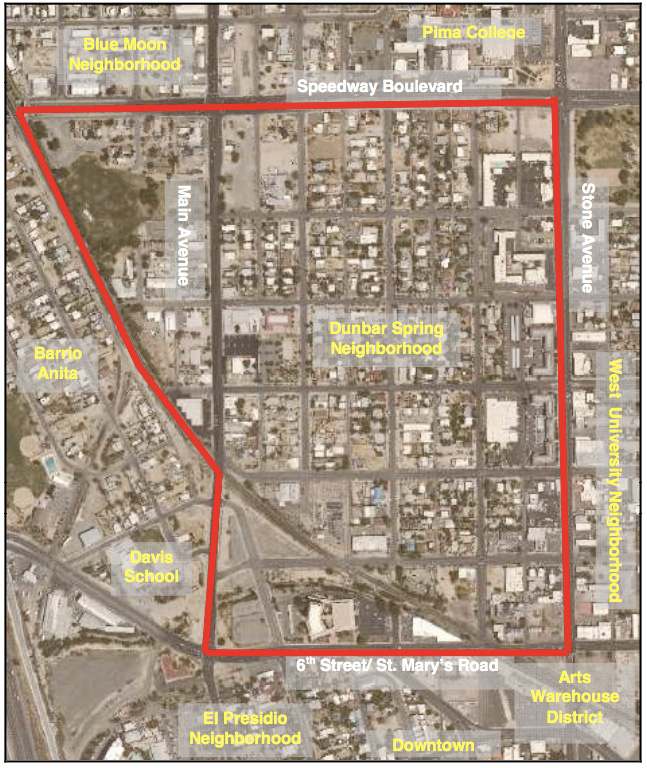
The Dunbar/Spring Neighborhood is a small, historic, and culturally and economically diverse neighborhood located at the north end of downtown Tucson. The name Dunbar/Spring (not “springs”) is derived from one prominent Tucson citizen, John Spring, who was one of Tucson’s first teachers, and an African-American poet, Paul Lawrence Dunbar. Dunbar/Spring has had a strong cultural identity as the first African-American neighborhood in Tucson.
The neighborhood is home to several churches as well as social service agencies, including the Salvation Army Hospitality House and Caridad Community Kitchen run by the Community Food Bank. Following the decline of downtown by the turn of last century, the neighborhood suffered from crime, abandoned properties, disinvestment, and encroaching commercial development that was harming the residential fabric of the neighborhood. Thanks to the commitment and energy of an increasing number of newcomers, combined with the historical wisdom and values of our long-term residents, Dunbar/Spring has continued to grow and change and is currently a vibrant community.
Dunbar/Spring and the Downtown Community.
The Dunbar/Spring neighborhood is bordered by Speedway Boulevard to the north, Stone Avenue to the east, (former) Sixth Street to the south, and the Union Pacific railroad to the west. Our neighbors are Barrio Blue Moon to the north, Barrio Anita to the west, El Presidio and the Arts Warehouse District to the south, and West University to the east. We are represented by Tucson Ward I and Pima County District 5 (Precinct 143). We are in state legislative district 20 and Congressional district 7.
The current Dunbar/Spring Neighborhood Association (DSNA) was formed in the 1980s, combining the former Dunbar Neighborhood Association with the John Spring Neighborhood Association. Prior to the new association being formed, neighborhood groups fought against each other and relations were strained, if not acrimonious. Since then, neighborhood elders, leaders, and activists have worked cooperatively to bring together a diverse neighborhood under the main goal of making it a better place to live. Crime rates have dropped, abandoned houses have been rescued and restored, new families have moved in or have been started, and the neighborhood has become a more desirable place to live. Along with this desirability comes a degree of gentrification, which has changed the neighborhood in various ways. Home prices and property taxes have increased dramatically, in fits and starts.
Neighborhood relations have improved and Dunbar/Spring residents are generally of the same mindset on most issues. Challenges will of course remain, given the diversity and long history of Dunbar/Spring. In recent decades a resurgent economy in and around downtown has changed the area and been both good and bad for Dunbar/Spring neighbors and the downtown area as a whole.
Dunbar/Spring is unique in that all residents and businesses are entitled to be a member of DSNA (including renters and owners, resident or not). DSNA advocates on behalf of members of all kinds. DSNA is governed by an elected board consisting of a president, vice president, secretary, treasurer, and parliamentarian. General membership meetings are held the 3rd Monday evening of every month in the Dunbar School, with the exception of Martin Luther King Day in January. DSNA collects no fees or dues from members, but produces an informative newsletter that is mailed to all residents at least once a year. The neighborhood also has this robust website, as well as a listserv that fosters regular communication, including information about upcoming meetings and events.